Showing posts with label Culture. Show all posts

Saturday, July 12, 2014

For Now, Good Bye to Seoul

After a meaningful 2 weeks in Seoul, Korea, I am finally going back. My training has been a  great achievement. I had the opportunity of being trained by some of the best analysts in the world. At the end of our training, fours of us, -me and my friends from Bangladesh, Philippines and Sri Lanka, we all learned that report writing is fun but at the same time can be sensitive too. In my opinion, I think it takes a lot of experience.


Although, we thought that DSA of $30 was a lot of money in the beginning, somewhere in the middle we came to realize that it was little less. I had to skip some meals to adjust my budget. But however in the end, with the supreme hospitality of our hosts, Korean Customs and other RILO AP officials, we actually thrived on that $30. All of us had lot to shop in the Meongdong market, all of us bought a lot of beautiful Korean souvenirs. I remain ever grateful to all the RILO AP officials for being so so generous with us. Even in our drunkard state, we all agreed that we are humans beings first and we feel for each other, irrespective of our diverse nationality.
With Deputy Head of RILO AP (tallest in the group) 
I will remember those dinners, both private and official. Our drinking sessions with lot of sensual communications had been a truly a memorable one. I will remember Mr. Nasier of Bangladesh singing "Ari-ari rang- suri-suri-rang" and touching the hearts of our Korean friends. I will also remember the lively atmosphere our RILO AP Head and Deputy head  had created during our official dinners and luncheons. They are truly intelligent and witty people. Probably that explains why Korean Customs administration is one of the best in the world. 


Our cultural excursion was even memorable. I had the good opportunity of visiting some of the UNESCO heritage sites in Seoul. By the way, South Korea have 10 cultural sites and 1 Natural site listed as UNESCO heritage site. The geomancy of Korean architecture is truly spellbinding.  Starting from the roof top to window panes, each part have a holy and auspicious significance of  their own. For example, during the last King of Joseon dynasty, the palace for the Price was built in the east, because Korean people believed that Price is like a rising Sun.
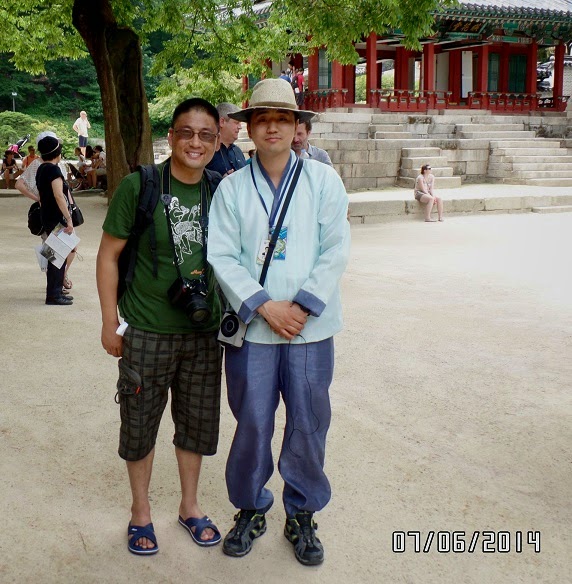
With female Culture Guide
Tour guides in their traditional Chima (for ladies) and Majoga (for men) dress at the sites are even more enthralling. They display a lot of pride and happiness in their cultural heritage. Although its a second language for them, they speak flawless English. They do no fumble like some of our guides in Bhutan. To, me they are a living history book. they are the stars of Korean culture. 
Female Culture Guide
I was told that most of the cultural sites were once destroyed by the invading forces of Japan. However they were rebuilt to their original glory. Unlike in many other countries, they were not left to ruin. One of the guides told the Japanese people in our group to take it as History. She said, otherwise the Koreans love Japanese. You see, they are even diplomatic!  
with a male  Korean Culture Guide
With these beautiful moments, I would like to bid good bye to this beautiful country. But someday, I would love to come back again. Anneongi-gaseyo

Monday, April 14, 2014

Paro Tsechu Post

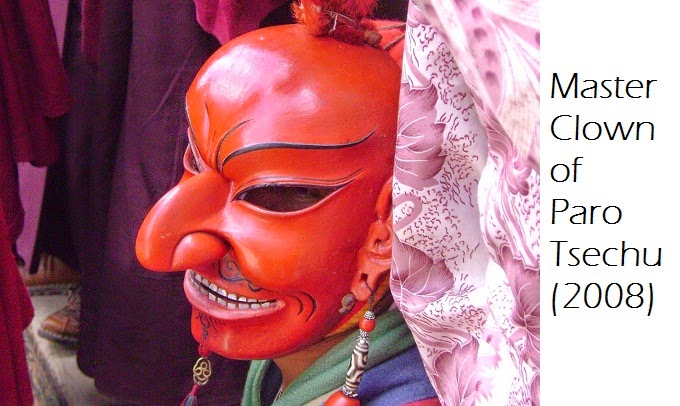
I think for Parops, Paro Tsechu is a specialty of its own kind. Its arguably, the most cherished culture in Bhutan. For some, its plain beginning of spring season, a season of hope and anticipation.. But for locals, it marks the beginning of many things. I see blossomed peach trees and the lush willows, marking the beginning of bountiful year, Tshechu is no different. I think It heralds the beginning of all good things between earth and the sky for the people of Paro.

Tuesday, April 1, 2014

Blessings of Shingkhar

Below is the full article on Shingkhar by Dr. Karma Phuntsho. It is featured in the in-flight magazine of Bhutan Airlines; "Kuzugangpo la" and therefore, people who have travelled recently in Bhutan Airlines,  must have read it already. But with kind permission from Dr. Karma, I am sharing this article on my blog for my personal record. I hope Bhutan Airlines do not mind like I did not mind with them when they used my pictures without credit. Anyways have a nice read and please look how I look with Dr. Karma

Wednesday, December 19, 2012

Something about Bhutan and Gujarat

I have a friend whose mom is a School Principal here in Gujarat. She told me that her mom actually wanted me to be the Chief Guest for her School's upcoming function. She wanted me to say few words about Gujarat and Bhutan. But unfortunately I have exams to write next week. So I was asked to record a message for the function. I wrote the following message. I even bought tripod for my camera so that I can video tape it and send it. I created a mini studio in my room but I bitterly failed to speak in front of camera. I tried the whole day, but simply couldn't get it......... God! I never thought speaking in front of camera could be that difficult. Please read my short message anyways.


Kemcho and hello to you all.


First up, I am sorry for not being able to join you all on this event. 

I am Kuenzang from a country, much smaller than your state. its called Bhutan. It is a beautiful country in the Himalayas  whose major population constitutes Buddhist people.

Our country became full-fledged democracy  in 2008. We call it  a Constitutional Democratic Monarchy, which is quite similar to the form of Government they have in England. They have queen, but we have our King. We,Bhutanese revere him as a symbol of  our unity.

Our country is the first country to adopt Happiness as the development policy. Our previous King said Gross National Happiness is more important than Gross national Product. No doubt, It became very popular. But, today this statement is often misinterpreted. Many people think Bhutan is the happiest country and Bhutanese, the happiest people on earth. It is not like that. We do have many challenges and obstacles before us. But despite all these challenges, we are one country who firmly believes that happiness is still possible.

What’s common in us? Love for peace, Spiritualism, innocent people and tasty food including products of amul.

Thanks to Gujarat & Anand, we have most of the Amul products in our country. Today people of Bhutan wouldn’t fancy a meal without Amul Cheese and tea without Amul Taza. Thanks Amul and Thank to the pioneers of Amul Dairy.


All the Best

Aavajo. Bhutan ma tamaru swagat chhe.

Wednesday, December 12, 2012

Massage from Lama Ngodup to All the Shingkharpas


Wonderful information. I thank our Ap lama for his effort and time in putting up this update for the information of all the Shingkharpas, both near and afar. I hope all the Shingkharpas get both the message and the meaning of the message clearly.

By the way how about we keep our Rabnye's date fixed according to our tradition that prevailed long time. i.e. on the the fifteen day of tenth month in Bhutanese calender which roughly coincides with December of the Gregorian calender? (Daw Chupay Tse Chai nga na)

I think all the civil servants and people working else where should also join for our sacred Rabney from here on because preserving Shingkhar's tradition, which otherwise is like our identity, do not only fall on Lama, Gomchens and the villagers.  Big or small, I think all the Shingkharpas should play their respective roles. We all must come together  to preserve our tradition & culture and pass it on to our future generation. Who knows may be this could very well bring more unity and harmony in our village. 

With best regards to all my fellas.

Monday, November 12, 2012

Diwali Once Again


Well friends, its Diwali here in India and I am on a very long break. But with my external exams soon to follow after the breaks, I am not in a position to plan anything grand. However my books, blog and Facebook are keeping me engaged most of the time. Other than number of hits on my blog, I also wish that Google have services to also record the number of hours I spend on my blog!  

Recently with the help of my brother, (Tenzin, also known as clever) I was able to connect my Facebook and Twitter account directly to my blog. I think, this has greatly enabled my blog to find some more readers. So thank you brother for your kind service. Not only that, I have also sent my personal request to some of my regular readers to join my blog too. 

I don't know how we met on social network, but Gyatso from Sikkim is one such person to whom I have  also extended my invitation. She wrote to me about how she spent her entire day reading my blog. And towards evening, these were the comments I got from her on my Facebook wall: 
"after reading your blog, i can just say that..........you arr not only witty but wise too, not only a son but a legacy, not only a dad but a father too, not only a husband but a companion too, not only a friend but a gift in disguise.......so remain the same forever, proud to have u in my friend list....... shall treasure our friendship......yeah your writings are flawless n the words well executed  to be more precise its original and well explained ........one reading is not enough..........keep up ...and continue writing"
I know Gyatso is being very kind and generous with her words. But nevertheless, I accepted her words with utmost humility. I took her words as the Diwali gift from her. With so many inherent flaws and weaknesses, I know I am a man far from Gyatsho's description, but with this gift from her, I now have a reason to believe that I can at least endeavor to become a good human being. 

By the way, yesterday, I was out for a while to have my hair cut. I wanted an army hair cut, but the barber said I wont look good with army hair cut in Diwali. So I had to settle for a normal trimming. I was told that Diwali is a shopping season and that was exactly what I saw. People were in shopping frenzy!

'Not buying anything in Diwali, I thought would tantamount to 'being (un) Indian on Indian soil' just like not being a 'Roman in Rome', so to show my deepest respect to the Indian culture, I ordered a book via homeshop.com and also bought some fire crackers and some colour lights for my room. I decorated the picture of Buddha in my room and it honestly it looks great and feels great! I also bought some candles and sweets too. On Diwali night (i.e on 13th Nov, 2012) I wanted to light the candles and pray for the world peace. 

I think Diwali is a Hindu festival that can be celebrated by people all over the world. It is a triumph of good  and colour over evil and dullness. So I wish all my readers a very happy Diwali. May the sun of happiness shine forever in this world.

Saturday, September 22, 2012

Blessed Rainy day Post (or Thrue Baap Post)

Picture Courtesy: Samten Wangdi
Thrue Baap (or the blessed rainy day) for Bhutanse is a very auspicious and sacred day. It is a day to cleanse both our body and mind from the sins we have committed both knowingly and unknowingly. People believe in taking bath with sanctified water with flowers. Bathing hours are however prescribed by astrologers. It is a day to cherish our bygone monsoon and welcome our much awaited autumn. Its the beginning of bountiful  autumn season! -the season of offering and season of thanksgiving!. All in all, its a day that merits happy celebration with full mirth. In Bhutanese calender, it also marks the end of rainy season for the year.

Back home, besides bathing, my family have a  tradition of visiting a temple on this day and make an offering. And more than that it used to be a happy family reunion too. I used to take my family to meet my relatives and siblings. We eat a lot and get drunk! and come home with lots of happy memories and nostalgic feelings. 

Since, I cound't be with my family this year, I thought it would be worthwhile for me to try and to put up a post worthy of thrue baap for my readers. 

You see, one year ago, I landed in a strange place called Gujarat. Without the slightest knowledge about the place, I felt the total strangeness in both place and the people. Trust me it is not an exaggeration. Hot, humid, dusty, messy and noisy, I disliked the place from the core of my heart. I felt immensely bitter and that I cursed not only the place but also the people who sent me here.  At times I found myself inconsolable and I longed to go home quick and swift. 

I suffered worst, when classes were taken in Gujarati medium. I felt suffocated and lost listening to a language which I knew nothing about. It was the testing time for my patience. But in between, when lectures were taken in English, it brought me much needed relief and respite. So when ever lectures were taken in Gujarati, I considered my self to a sinking duck in the water and to a floating duck when lecture resumed in English. 

And away from my college, people in the street, mall and shop gossip openly about me. Most of them mistook me for a Chinese guy. On seeing me they giggle at first and shout "Chingka" on top of their voice. For once I thought to myself that Chingkas are to most Gujaratis what toys are to kids. So I had that dying urge to learn their language and someday talk to them on equal terms.

Now in my second year here in Gujarat, I have not only learned to communicate at basic level, but I have also made a good progress in learning some Gujarati terms in Economics too. I feel I am not a sinking duck any more. I tell people not to gossip about me on their face. Check my Gujarati -Economics vocabulary :

Sl No  Gujarati Word Equivalent English Word 
1 Arth sans thra  Economics
2 Samtula  Equilibrium
3 Simanm  Marginal 
4 Khartz Cost
5 Mang Demand
6 Vikas  development 
7 Veshnikaran Globalization
8 Arthik  Finance
9 Jokham  Risk
10 Fer faro Change
11 Apekshath  Expectation
12 Upathpadan Productin
13 Vektheno Individual
14 Jayar Dev Public Debt
15 Jurwa mati  To see
16 Prayath  Available
17 Esteeth Neutral
18 Sangkalan  Integration
19 Tika  Criticisims
20 Miriadav Limitations
21 Purna Harifai Perfect Competition
22 Ijarat Harifai Monlpolistic Competition
23 Tafni Technology
24 Awakath  Income/ output
25 Rajai Sarkar State Government 
26 Dhana  Assumptions
27 Jakatnu  Tariff/ Customs Duty
28 Sudra  Ammendment
29 Jayar Shetra  Public Sector 
30 Purna fura  Reallocation
31 Isttam Optimum
32 Mahatum Maximum
33 Wage Vethan
34 Rent Bhadu
35 Profit Nafo
36 Saras Important
37 Juda different 
38 Juno Old
39 Muko Put
40 Acho-kas-tam Uncertainity
41 Policy Niti
42 Parman  Quantity
43 Samai Time
44 Purna Rozgar Full employment
45 Pragati progress
46 Achar  Constant
47 Bhagani Exogenous 
48 Lamba gara  Long run
49 Phugaw Inflation
            50               Ochu                                           Less
            51             Vadaro                                     Increase/grow 
These are commonly used words in my class. I can now proudly listen to my professors and node my head in satisfaction.  Believe me, I can also speak some sentences! This has surprised many of my class mates.

By the way, dear friends, I wish you all a very very happy blessed "rainy" day. May you all have a prosperous year ahead. 

Monday, September 17, 2012

Yak-lha, The Lost Culture of Shingkhar


In a folk tale heard in select regions of Bhutan, a story unfolds about a significant encounter between two masters: one from the Bon Tradition named Ode Gongjan and the other from Buddhism, Guru Rinpoche. Ode Gongjan, also known as a Bonpo, was a formidable master in the predominant Bon faith. However, with the arrival of Guru Rinpoche, a shift in supremacy seemed imminent. To establish dominance, a debate between the two masters ensued for days, weeks, and even months, yet no clear victor emerged from this prolonged contest.

In a bid to break the stalemate, the two masters agreed to engage in another set of contests, this time showcasing their supernatural powers. They decided on a competition to reach the summit of the famous mythical mountain, Gangkar Tse, by the time the first rays of the sun touched the peak the following day. With the contest scheduled for the next morning, both masters parted ways to prepare.

That night, while Guru Rinpoche remained in deep meditation, Ode Gongjan initiated his challenge. He rode on the sound of a drum, covering vast distances with each beat throughout the entire night. As dawn broke the next day, Guru Rinpoche rode on the rays of the sun, surpassing Ode Gongjan. Although Guru Rinpoche narrowly edged out Ode Gongjan, securing victory, the win was close. In a fit of rage and embarrassment, Ode Gongjan hurled the drum that had propelled him down the valley, causing half of the mountain to collapse. His uncontrollable fury and shame at the loss of the contest were palpable in that moment.

As the defeated party, Ode Gongjan was obligated to depart the area and relinquish his followers, who had previously revered and provided offerings to him. However, as Ode Gongjan prepared to leave, Guru Rinpoche consoled him and decreed that he could not only continue practicing his Bon faith, but would also be entitled to receive grand monthly offerings from various regions. This gesture by Guru Rinpoche demonstrated compassion and a desire to preserve the religious diversity of the region, even after his victory in the contest.

Guru Rinpoche decreed that Ode Gongjan, the defeated Bon master, would continue to be revered by the people of the valley, which corresponds to the present-day regions of Bumthang, Lhuntse, Mongar, and Zhemgang in Bhutan. Ode Gongjan was to be worshipped as a deity who protects livestock, and offerings would be made at places where livestock congregate. This arrangement allowed the Bon tradition to coexist alongside the growing influence of Buddhism in the region, demonstrating Guru Rinpoche's compassion and desire to preserve religious diversity.

The Yak-lha festival in Shingkhar is an annual offering made to honor Ode Gongjan, the defeated Bon master from the folk tale. The festival coincides with the 15th day of the 7th month in the Bhutanese calendar. It was once a popular celebration and gathering among the yak herding communities of Shingkhar. During the festival, Ode Gongjan is ushered to the altar in the evening, and texts praising him are recited throughout the night. The only musical instrument used is the drum. The following day, Ode Gongjan is bid farewell. Although the occasion brings festivity, the ceremony reflects the vanquished status of Ode Gongjan, as decreed by Guru Rinpoche in the folk tale.

The tradition of yak rearing in Shingkhar has significantly declined due to the changing lifestyle of the community, leading to a fading of the once vibrant cultural practices. Nowadays, only a few individuals partake in the occasion, and the tradition is rapidly fading into obscurity. Presently, the hills of Shingkhar are only graced by yaks that have been rescued from slaughterhouses, symbolizing a poignant shift in the cultural landscape of the region.

Wednesday, May 23, 2012

Up Coming Thongdrel of Longchenpa in Shingkhar

༈ གངས་རི་ཐོད་དཀར་རིན་ཆེན་སྙིང་པོའི་མགོན། །
ཡོན་ཏན་ཀུན་བྱུང་དགའ་བའི་སྐྱེད་ཚལ་དུ། །
སྙིགས་མའི་དོན་གཟིགས་སྦས་པའི་རྣལ་འབྱོར་པ། །
ཀློང་ཆེན་རབ་འབྱམས་ཞབས་ལ་གསོལ་བ་འདེབས།།

I have picked up this picture from the facebook page of Shingkharpas. I am deeply moved by the initiatives taken by my brother who is a Bhutanese astrologer in Pangrizampa. I hope to see him succeed in his endeavor. I hope the blessings of Longchenpa will continue to bring the peace and wellbeing in Shingkhar (in particular) and Bhutan and  the World (in general)

My brother, Soman Rinchen, Bhutnese Astrologer
I would like to convey my sincerest and deepest Tashi Delek to Sonam. I would also like my readers everywhere in the world to join me in wishing him a  great success. 


Wednesday, February 29, 2012

Shingkhar Rabney Part 4

Yeedam

The life size copper statue of Buddha, known as the yeedam to locality is one of the most sanctified and chief relic housed in Shingkhar Lhakhnag. It is also known as Yeedam Khamsum Zoelnon. Although its history and origin are not much known, (even to the majority of the locals) the statue is revered to as the wish granting object besides being worshipped as Buddhist artifact. 

This wish granting stuff might sound little naive and silly. But if you are a Buddhist, then It might sound little remarkable and captivating.

Long time ago, a tax collector from the court of erstwhile Debraja visited Shingkhar. Little did he realize that he was there for a dual purpose? –he was there to not only collect taxes, but on repeated persuasion from the locals, he was also there to make a secret wish that was going to have a lasting impact in his life. 

Although, his wishes were not explicitly revealed, implicitly, it was his wish to become Paro Penlop in a very foreseeable future. Should the wish come true, he then made a secret vow to install Golden Pinnacle (serthok) on the roof of Shingkhar Lhakhang in gratitude.

Amazingly, the tax collector, popularly known as Agay Haap became Paro Penlop shortly. Not only that, he also become the first person to install serthok on the roof Shingkhar Lhakhang as promised.

There are many such stories. If anybody is interested, then please visit Shingkhar Lhakhang. Remember me, if your wishes come true.


Serthok of Shingkhar Lhakhang 

Tuesday, February 28, 2012

Shingkhar Rabney, Part 3


Shingkhar has been a place of mystery for eons. It still continues to be. Shingkhar is a place known not only  for innocent yet intriguing people, but is also known for its rituals and relics it has in abundance. 


Of many such relics, the the mask dance of Lhamo and Gyembo are the towering show piece by any measure. Perchance, they are the specialty of the region whose sacredness awes many mortals. By locals' definition, the history of these dance are as old and as untraceable as the history of the universe itself.

However, sources, tend to suggest that, those mask dances were initially composed and initiated by second Shingkhar Lama, known as Lama Jabodma. Lama Jabodma was the son of first Shingkhar Lam, Tsezang Thaye Drakpa, who in turn was the great gand son of great Nyingmapa master Longchen Rabjam.
The current mask of Lhamo and Gyembo are believed to have been curved by Lama Jabodma himself.  It was  believed that Lama Jabodma and many other magical powers. 

According to locals', Lama had the supernatural power with which he toured India and Tibet in a single day. Perhaps, that's why he was named Lama Ja (meaning India) Bod (meaning Tibet)

 Literally, Lhamo is a female Goddess and Gyembo is a Male God. Lhamo is in white clad, Gyembo in dark blue. They are considered as the Choesungs (the guardian deities, who protect Buddha, Dharma and Sangya) of the region. In Bhutan there are many such Lhamos and Gyembos. Accordingly, Lhamo in Shingkhar is  Durthrod Lhamo (?) and Gyembo, Gyembo Maning.  

Shingkhar Rabney is the only occasion to see these dances. 

Saturday, February 25, 2012

Shingkhar Rabney, Part 2

Dear friends and folks,

Chath Dorji here.

Well, the thing of Rabney is long over and gone. I am now back in Golaipang, safe and sound with my family. I had the most memorable Rabney of my life. I think I will never forget the happy moments I had with happy folks of Shingkhar. 

When I was a young boy, My mysterious father and mother would always tell me stories about the mythical Lhamo and  terrifying Gyembo. One story that I vividly remember is the story  about Choejong, their Yak,  who farted so bad that  it blew up the nose of Gyembo on their way back to Golaipang after Rabney. That's why  today, Gyembo has a nose, that looks somewhat flattened with its tip raised.

That is just one side of the story. (especially for curious kids) 

The real story, as far as the history goes is that, it goes as back to the time of great Nyingpa master, Longchen  Rabjam himself. It is believed that when Longchenpa was mediating in the Tibetan region called Gangri Thoed Kar, the mermaid, (Tshomen) who resided in the lake called Mapham Yumtsho invited the master on many occasions. Although he rejected the initial invitations, he however consented at last to visit the lake once. 

When he finally visited the lake, the mermaid requested him to discover something from the lake as Ter (treasure). As requested, Longchenpa discovered a pair of white horn that belonged to a yak. 

The master carried those pair of horns with him to Shingkhar. Later when Longchenpa established his seat in Shingkhar, those pair of horns became the main relic of Shingkhar Lhakhang. 

Many years after Longchenpa, his disciples composed a dance of a yak. They used the same horn which Longchenpa carried from Tibet. It came to be known as Choejong.  Today it is considered as the most sacred relic of the valley. 

Friday, February 3, 2012

Shingkhar Rabney, Part I

Shingkhar Ranbey 2008
Shingkhar Rabney concluded on 2nd Feb 2012, (which coincides with the 10th day of 12th month in Bhutanese calendar) It’s an annual event that lasts for 5 days. Locally, those five days are considered auspicious and sacred. They are considered most important for many reasons. 

Firstly, even though the significance of Rabney extends far beyond, for locals, it is considered as an annual event honoring our local deities for all the blessings and protections they have rendered in the past year. Besides, it is also an event where folks celebrate their past success and embark on the new beginning. 

Secondly, Rabney is a unique local event, observed in the loving memory of our ancestors. They are remembered for all the hardships and pains they have endured to preserve this beautiful culture and tradition. It is with each passing Rabney, that the architects of Shingkhar are immortalized in the hearts of Shingkharpas. 

Thirdly, Rabney is an important social event that unites the family and long lost relatives. It is often on Rabney that parents see their children who have moved to a far off place. It is also time for all the folks to call off the days form mundanely chores and sing and soak, heart and soul  in local brew -ara and cingchang.

Tuesday, May 31, 2011

Guest post: By Dr Karma Phuntsho, In response to Dzongsar Jamyang Khyentse Rimpoche


14 May 2010:The recent article in Kuensel by Dzongsar Jamyang Khyentse contains a refreshing perspective and no doubt comes from one of the most influential and intelligent minds in our country. We must be thankful to Rinpoche for indeed only a few of our religious leaders embodying traditional knowledge and values are able to discuss social issues in a popular idiom. However, does the article provide us truly constructive suggestions? Can we imbibe inspiration from it beyond what is merely granted by religious reverence? I agree with many things Rinpoche has to say and they need no reiteration. However, despite providing a compelling piece to read, the article seems to paint a dismal picture of Bhutan. Is there really such a cultural stagnation? Some of the ideas the article implicitly advances may even prove to be harmful for Bhutan in the long run.

The issue of greed and laidback attitude is a good one to begin with. While I fully support Rinpoche’s campaign against greed, I beg to differ in talking about greed and ambition in ambiguous terms. There is a fine line between the two, as we all know in theory. Ambition should not be mistaken for greed, just as love should not be mistaken for attachment. There is, as it were, already too much laidback culture in the Bhutanese society. It is mainly due to such laidback attitude, often mistaken for contentment, that our public services are poor and institutions such as the civil service thrives on the basis of a power structure rather than efficiency. It is primarily responsible for the mediocre performance in the arts and crafts industry, of which Rinpoche has many examples to quote. It stifles our economy. Bhutanese must work hard and even harder if we are to excel and prosper.

At the core of our progress is education – the right kind of education. I personally do not buy the Laotian saying that too much education makes one unhappy, which Rinpoche cites to begin his piece. Ignorance may be bliss temporarily but not in the long run. In the true spirit of Buddhist pursuit of omniscience and ultimate happiness, Bhutanese should set no limit to their educational pursuit and personal development. For a small country with limited resources, our best future is perhaps in building a knowledge based industry.

The problem of dignity of labour, which Rinpoche raises, is certainly a pressing one. This is partly to be blamed for the problem of unemployment we face. Yet, it is not just a structural problem arising from the hierarchy in the civil service. It is deeply ingrained in the Bhutanese mentality. There is no doubt that some high offices of the state make excessive use of the symbols of hierarchy. But we must also remember that most of these ideas and insignias of hierarchy originate in religious institutions and are still reinforced by them. The hierarchical settings in the religious institutions themselves are appalling and ordinary people, especially women, cannot even question them. Positions are marked by birth and insignias and rarely by inner merits, which Buddhism is supposed to be all about.

Given this situation, perhaps the first step and best way to challenge and start deconstructing the hierarchical mentality is for the religious figures to set examples. Rinpoche, we know, is at the forefront of reforming some of the religious practices and we hope his works will lead to some systemic changes.

This leads to the discussion of creativity in cultural transformation. While we all seem to agree that some cultural practices will have to go, it is difficult to agree on what exactly should go or stay. Should the gho and kira go because many find them inconvenient? Should the zhugdrel ceremony go because it is purely a ritual? If so, what would be left behind to make us truly Bhutanese? It is no easy decision to make but so far Bhutan has done very well in balancing modernity with tradition.

There is a dire need for the subtle discrimination, as Rinpoche points out, in making our choices. Unfortunately, the Bhutanese populace in general  do not have the exposure to appreciate the finesse of Zen style or the wealth to incorporate sanitary facilities in rammed mud houses like Aman does (to use his examples). While this remains, the state is obliged to make certain choices sometimes obstructing the choices of individuals. To give in to the sway of passing popular taste is being short sighted. So, the argument to change with time is not always pertinent or persuasive. History is not always about dancing to the tune of time. Bhutan must design its own future and hold its ground firmly and not resign to the pressure of time or external forces. Today, many people in the world are looking up to Bhutan for inspiration to find a new order of life without losing the old. It will be a shame for us to let the old erode so easily.

The suggestion for replacing Dzongkha by English as lingua franca may come as a timely argument for many. It would certainly strike a chord with some elites and youth who increasingly prefer to use English as their medium of communication. But what does such a suggestion portend for Bhutan’s future? Bhutanese languages are declining fast as they are. Some are already on the brink of extinction. The only sensible call would be for any support to preserve them as long as we can. I am not myself a fan or native speaker of Dzongkha but having English in place of Dzongkha is not going to leave us in any better situation. As a new literary language, Dzongkha has made remarkable progress despite the reluctance on the part of most people to invest even a tenth of the time they devote to English.

The Indian case, which Rinpoche uses, is a good one to illustrate the linguistic disaster we will go through, if English is made the common language. Ever since English became a common language in India, literary activity in local languages such as Tamil, Kannada, Telephu, Maratha and even Hindi and Urdu dropped drastically and the related cultures are ebbing away. Many people have native tongues which they cannot even speak well and most youth have no first language, a scenario we see in Thimphu too. NDTV is a good example of linguistic adulteration. In comparison, our languages are spoken by a very small number of people. Like it or not, English will be the weed to kill our linguistic flora.

The death of a language is the demise of a culture and we will be one culture poorer with the death of each language. While the adoption of all major Bhutanese languages as Constitutional languages is a fair and sensible suggestion, should English really become the unifying language as proposed? Instead of India, we may do better following the example of European countries such as Germany, where people proudly use their own tongue and also speak English fluently. It is a sign of weakness to resign to an easy and popular choice. Similarly, time and resources are not an issue unless we make them one. If it all, it is pressing that we reenergize our heritage and not leave it to its slow death. All conditions are favourable for Bhutan today to boost our economy, environment, culture and language and work towards GNH. Eventually, it will be our own heritage which will remain the defining strength and mark of our sovereignty as the fourth King noted. Short of our ethno-linguistic distinction, what will make us true Bhutanese?

Lastly, are these topics really ’sacred cows’? As far as I know, they are being debated constantly and Bhutan is not as closed as it may seem.

I write on these topics

105th National Day (2) 2012 (2) 2013 (1) 2014 (1) Academic (5) ACC (1) Accident (3) ADB (1) Ahmedabad Experience (15) Alto (1) American President (1) Animal Well-being (2) Animals (4) Anonymous (1) Archery (1) Architecture (2) Arrogant (1) Art (5) Asset (1) audicity of opinion (1) Autowalla (2) awards (1) baby sitting (1) BAFRA (1) Ban (1) Bank of Bhutan (2) Belief (1) Bhutan (61) Bhutan Airlines (2) Bhutanomics (1) Biggest Democracy (1) Birthday (7) Birthday Wishes for my King (4) Birthday. (1) Blessed rainy day (1) Blog (2) Blog Award (1) Blog Award. Bhutan (1) Bloggers (3) Bolg Award (1) Bonzai (1) Book (11) Boudha temple (1) Buddhism (19) Buffalo (1) Car (2) Changkor (1) Chetan Bhagat (1) Chief Election Commissioner of Bhutan (1) Child development (1) China (6) Choku (2) Chukha-Damche Bypass (1) CITES (2) Civil Servants (2) CNN (1) cold (2) College (1) Comment (1) common sense (1) Community (1) Conservation (1) Constitution of the Kingdom of Bhutan (2) contemplation (1) Cordycepts (2) corporal Punishment (1) Court case (8) cricket (1) Cricket World cup (1) crime (3) Culture (14) culture properties. (3) Customs (10) DANTAK (1) Dasho Kunzang Wangdi (1) Dasho Shingkhar Lam (1) Dawa Gyeltshen (1) DCT (1) DDC (1) Dechen Wangmo (1) Democracy (4) Department of Revenue and Customs (6) Depression (1) Development (2) Dictator (1) Diplomatic Relationship (1) Disaster (1) Diwali (4) DNT (1) Doctors (1) dog (1) Doomsday 2012 (1) DPT (1) Dr. Karma Phuntsho (1) Dr. Richard Teo (1) DRC (4) Dream (2) Drugs (1) Dungsey Rimpoche (1) Dylan Thomas (1) Dzongkha Song (5) Earth hour (1) East (1) Ecology (1) Economics (14) Economist (1) Economy (1) Education (10) Election (5) Election 2013 (3) Election Commission of Bhutan (1) End of the world (1) Enforcement (3) Eric Weiner (1) Essay Games and Sports (1) Exams (9) Eyelid Twitching (1) Eyes (1) Facebook (3) Family (6) Farewell (1) FIFA (1) Fire disaster (2) Flowers (5) Flu (1) Folk tale (1) Food (2) Football (3) Foreign Policy (1) Fourth King (4) Freedom (3) Freedom at midnight (1) friend (1) Friendship (2) Fun (1) fundamental right (1) Games (2) Gandinagar (1) Gangnam Style (1) global warming (1) GNH (6) Golf Course in Shingkhar (4) Government (2) Great Britain (1) Guest Post (1) Guest Post. Extra Marital Affairs. (1) Gujarat (32) Gujarat University (9) Guns in Bhutan (1) Guru Rimpoche (1) H. L. V. Derozio's (1) H.H Dalai Lama (1) Happiness (13) Happy new year (5) High land (1) His Majesty (4) History (4) Hobby (1) Hollywood (1) Home (6) Humbleness (1) humility (1) Humming bird (1) humor (2) I am Malala (1) I too had a love story (1) Iceland (1) Icon Shoe (1) IELTS (1) India (29) Indian Politics (1) Indo-Bhutan Friendship (1) Infatuation (1) Information (1) Inspiration (2) International Happiness day (1) International Health Regulation (1) International Poetry day (1) International water day (1) International Women's day (1) interview (2) Jangsa Animal Saving Trust (2) Japan (5) Jaswant Singh (1) JDWNR Hospital (8) job (1) John Keats (1) jokes (2) Joseon Dynasty (1) Justice (1) Kankaria lake (1) Katmandu (2) Kings of Bhutan (2) Kongfu Panda (2) Kuensel (3) Lal Darwaza (1) laughter (2) Law (4) Lemjakha (2) lessons (1) letter to MP (2) Letter. (1) Life (4) Loan (1) Local Healers (3) Lomba (1) Longchen Rabjam (9) Losar (2) love (6) Lunar Eclipse (2) Lyonpo Ugyen Tshering (1) Malaysia (5) Married to Bhutan (1) Mathematics (1) merry X-mas. (2) MH370 (1) middle class people (1) middle class people. My life (1) Ministry of Finance. Paro Airport (1) Minzuk Lhamo (2) Misfortune (2) MoE (1) MoF (1) Moldova (1) Money Plant (1) Monk hood (1) Monks (1) morales (2) Mother's Day (2) Movie (5) MPs (1) Music (3) my ATM card. (1) my blog (2) My Boss (4) my camera (1) my country (1) My daughters (14) My family (7) My father (9) My Friend (2) My job (5) My King (2) My King and Queen (4) My Life (76) My mother (4) My passport (1) My Phone (1) My Promises (1) My sister (3) My Son (1) my sun glass (1) My Teachers (2) My Wife (4) Narendra Modi (2) NASA (1) National anthem (1) National Assembly (1) National Day (1) NDTV (1) Nelson mandela (1) Nepal (4) Nissam Ezekil (1) Nomads (1) Norbu the Cat (1) Oldest Democracy (1) Our Queen (1) Palace (1) Parliament (1) Paro (3) Paro Airport (7) Passu (2) Pay Revision (4) PDP (1) Pedestrian day (1) People (3) Photography (34) Poetry (12) Police (2) Politics (6) Pollution (1) Prado (1) Prediction (1) Primary round (1) Prime Minister of Bhutan (2) Prime Minister of India (1) Private Sector (1) Prostitution (1) psychology (2) Punakha (2) Punishment (1) Qatar (1) Queen of Bhutan (1) Quota (1) RAA (1) Rabindranath Tagore (1) Rabney (2) Rajnikant (1) Random Thoughts (30) RCSC (2) reflection (1) Refugee Problem (1) Religion (4) Republic day of India (1) Research (2) Result (5) Retention wall (1) RILO AP (2) Road (1) Road Development (1) Road safety (1) Robert Frost (1) ROCB (1) Royal Wedding (4) RRCO. Paro (2) Rule of Law (1) Rumors (1) Rupee Crunch (2) scholarships (3) School (1) Security (2) Seminar (3) Seoul (3) shapes (2) Sherubtse (3) Shingkhar (34) Sikkim (1) SIM card (1) Singapore (1) Smile (1) Snowfall (1) social forestry day (1) Social Media (3) social problems (1) South Korea (8) Sperm Donation (1) Stipend (1) story (2) Study (2) Suhas Gopinath (1) Superstition (1) Switzerland (1) Talent (2) Tashi Group of Companies (1) Teachers (5) Teachers's Day (1) Team work (1) Thai Customs (3) Thailand (2) Thank you (2) Thank you note (1) The Nederlands (1) Thimphu (2) Thuksey Rimpoche (1) Tibet (3) tobacco (1) Tobacco Control Act (3) TOEFL (1) Trade (1) Traditions (4) Training (11) Travel (15) Tsechu (1) Tulip (1) Ugyen Pandy (2) Uniform (1) Ura (2) USA (1) vacation (1) Walk (1) Wangdi Dzong (2) WCO (4) Wedding (1) Welfare Contribution (1) WHO (1) wild life (1) wildlife (3) William Wordsworth (1) Wisdom (2) Women (2) Woochu (1) World CUP (1) Writer (1) Writing (1) Yak (11) Yeshhey (1) Youths (3) Zhabdrung (1) Zoo (1)